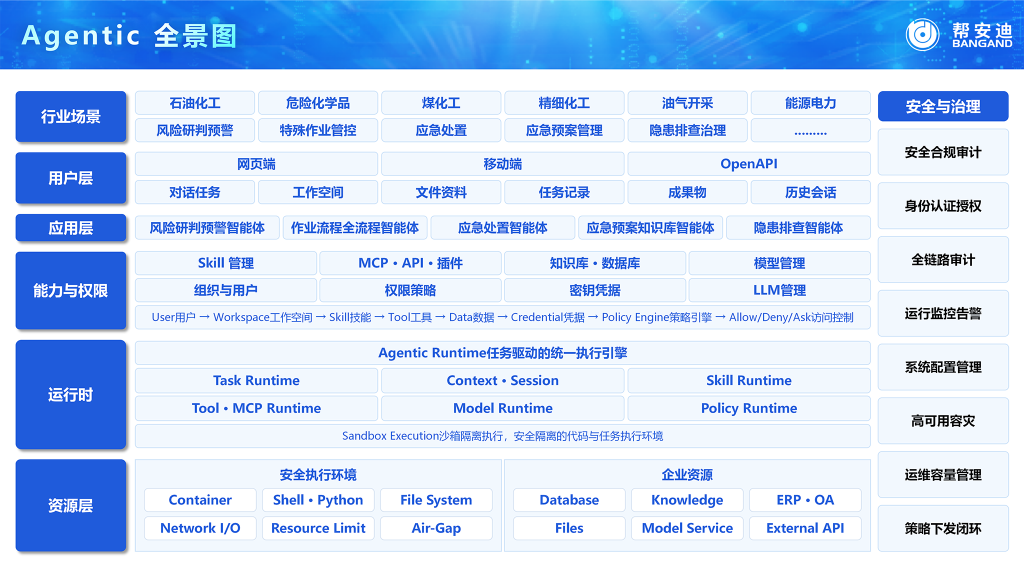
In industries such as petroleum, chemicals, coal mining, non-coal mines, and manufacturing, safety is the lifeline of high-quality development. Traditional safety management has long faced challenges such as data silos, reliance on experience, and ineffective closed-loop management. To address these issues, Beijing Bangandi Information Technology Co., Ltd. (hereinafter referred to as “Bangandi”) has launched the “AI Agent Platform” to drive safety management from “passive response” to “proactive prevention,” from “person watching person” to “data-driven,” and from “experience-based management” to “human-machine collaborative decision-making.” The platform integrates agent construction, workflow orchestration, and application publishing, and unifies the management of models, knowledge bases, and tools. It supports business personnel in independently building agents in both “instruction-based” and “workflow-based” modes, enabling dynamic scheduling of multiple models and RAG knowledge enhancement. Through key mechanisms such as spatial isolation and full-link auditing, it ensures execution is safe, controllable, and traceable. Focusing on industrial safety production scenarios, the platform has developed five core intelligent agents to build a full-chain closed loop of “perception—assessment—early warning—linkage—handling—review and improvement,” forming a full-scenario safety defense line.
1. Hidden Danger Inspection (Dual Prevention) Agent: Making Hidden Dangers “Accurately Photographed, Effectively Rectified, and Truly Closed-Loop”
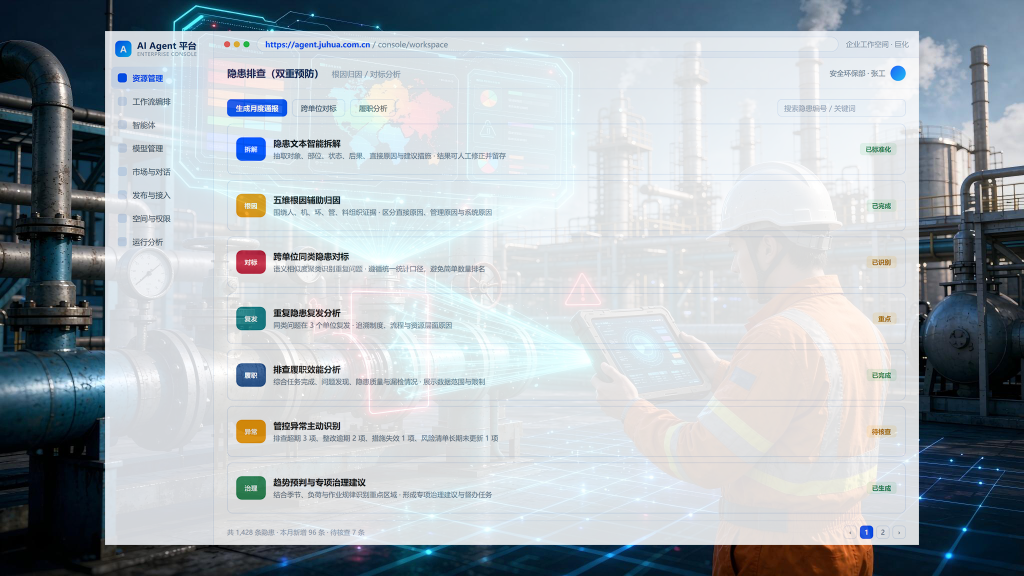
The dual prevention mechanism is the first line of defense in enterprise safety management. However, traditional operating models suffer from pain points such as inspections relying on experience, rectification being difficult to close the loop, and risk lists being updated belatedly, rendering the defense line virtually ineffective. This agent focuses on the operational quality of hierarchical control and hidden danger inspection and governance. It conducts semantic analysis, root-cause attribution, horizontal benchmarking, and trend assessment on hidden danger descriptions, rectification processes, inspection tasks, and risk lists, driving a deepening from problem closure to systematic governance. The agent supports AI multimodal hidden danger identification: photos can be taken to identify features and intelligently classify severity; voice can be used for rapid entry and extraction of key elements; the built-in “Ask Safety” function provides instant answers to compliance questions, rectification suggestions, and regulatory basis; it automatically generates and updates risk lists and identifies newly added risks during process changes; and it automatically generates inspection plans based on risk levels and frequencies and pushes them precisely. Management can overview the four-color risk distribution of the entire plant, the safety department coordinates risk identification and compliance audits, inspectors report via snapshots, and rectification responsible persons upload photos and videos, ensuring rectification is implemented.
2. Risk Assessment and Early Warning Agent: Making Risks “Visible, Traceable, and Preventable”
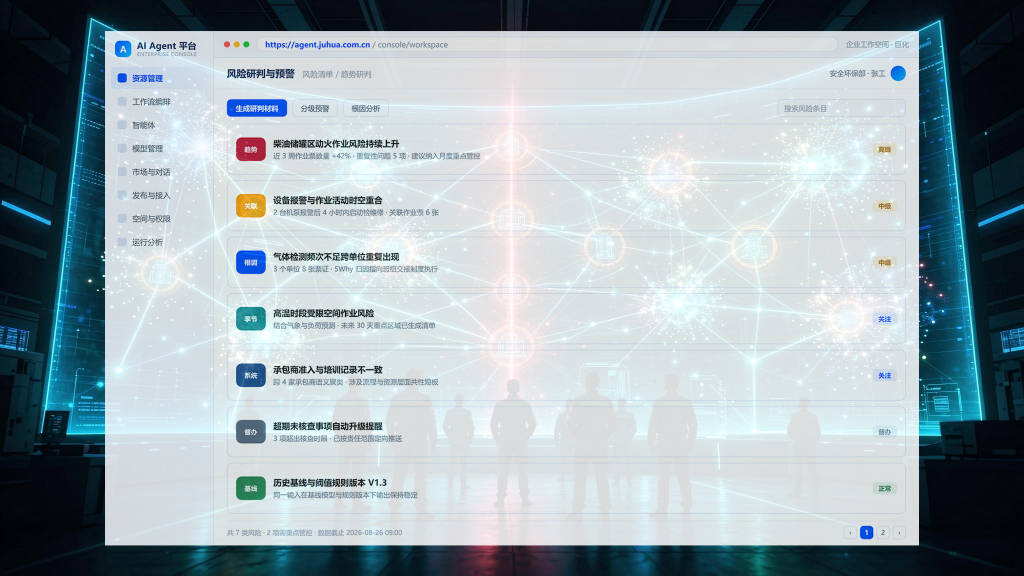
Unlike hidden danger inspection and governance, which focuses on “human inspection of static hidden dangers,” this agent focuses on “real-time assessment of dynamic risks” in production processes. It solves problems such as disconnected cross-system correlations in manual assessment, massive alarms obscuring real risks, broken traceability chains, invisible risk propagation paths, and decisions lacking root-cause support. The agent uniformly aggregates alarms from various systems to form “alarm event clusters,” breaking information silos; automatically generates visual correlation graphs to clearly display causal chains of events; outputs root-cause diagnostic reports within 60–120 seconds to precisely identify accident triggers; visually tracks upstream and downstream risk propagation paths to predict affected units and scope; and automatically determines warning levels, generates customized handling plans, and pushes them precisely. It serves decision-making and command levels, management and supervision levels, and execution and operation levels, achieving full-domain monitoring, closed-loop management, and precise execution.
3. Special Operations Full-Process Agent: Making High-Risk Operations “Authentic Permits, Transparent Processes, and Clear Responsibilities”
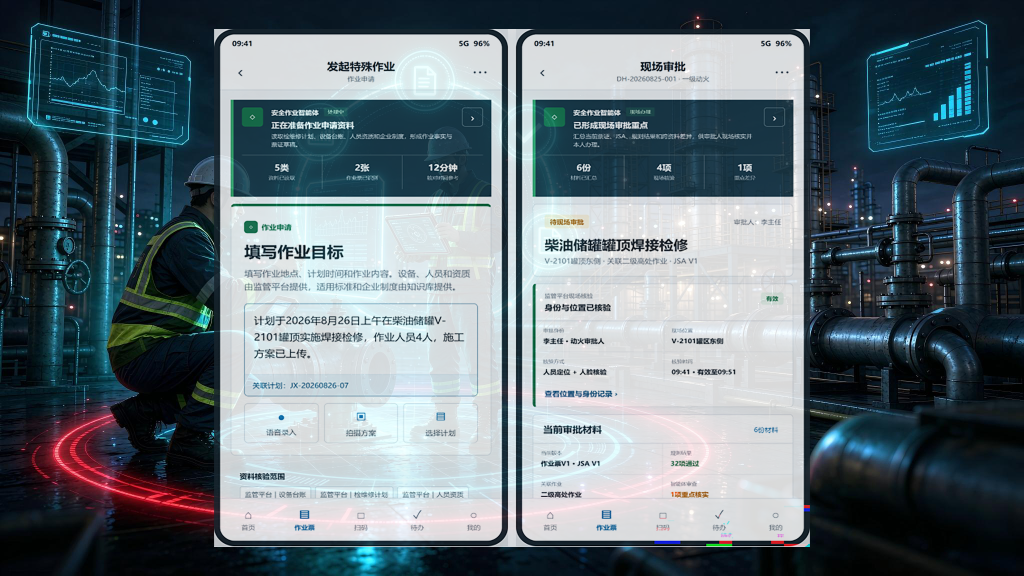
Special operations (such as hot work and confined space operations) are the core defense line of industrial enterprise safety management. Traditional models suffer from cumbersome processes, reliance on experience, and lack of supervision, leading to problems such as inefficient work permit management, inadequate risk identification, uncontrolled cross-operations, uneven personnel capabilities, and lack of full-process closed-loop supervision. Following the reconstruction logic of “analyze first, issue permits second, verify again, and leave traces throughout the process,” this agent connects the entire operation chain. Before operations, JSA intelligently generates risk analysis reports, all personnel confirm online via APP, and work permit drafts are generated on site. During approval, mandatory location check-in, on-site photos, and electronic signatures prevent “remote signing from the office.” During operations, supervisors verify in real time, gas detection data is automatically entered, regional conflicts are monitored in real time, illegal cross-operations trigger automatic warnings, and photos and videos of key nodes are uploaded. After operations, acceptance and closure are completed, forming a complete electronic archive. Responsible persons, approvers, supervisors, frontline personnel, and management each perform their duties, enabling full-chain responsibility traceability.
4. Emergency Plan Knowledge Base Agent: Making Plans “Accurately Prepared, Usable, and Quickly Updated”
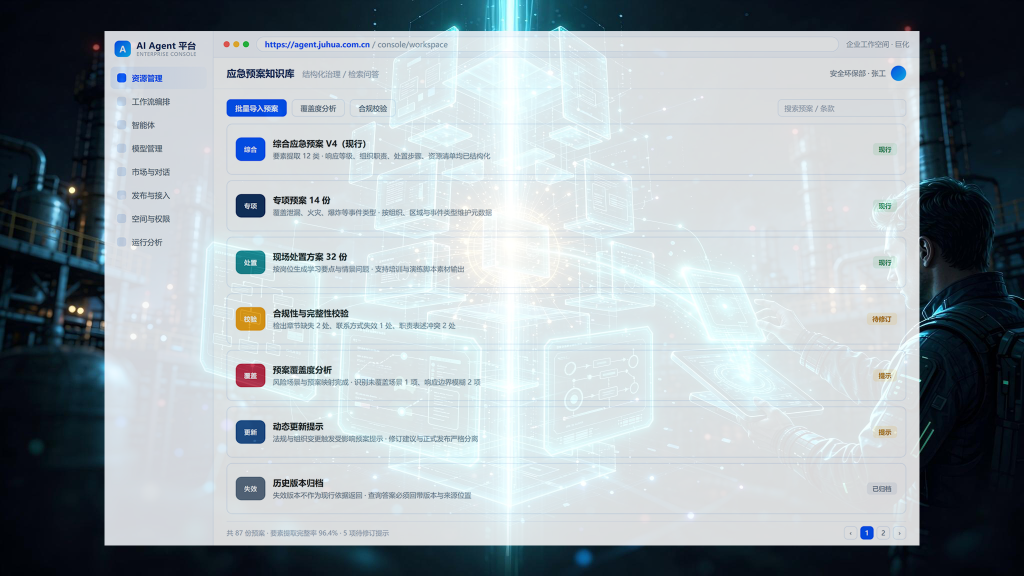
Traditional emergency plans are often “prepared but not used, used but not refined, and updated belatedly.” As a knowledge foundation running through the entire process, this agent builds a plan knowledge system covering enterprise and unit levels, transforming unstructured documents into retrievable, comparable, and traceable knowledge units that serve daily queries, incident handling, plan review, and training drills. It can generate structured plan drafts with one click, lowering the preparation threshold; automatically verify compliance and completeness and generate review opinions; support multi-version traceability, approval process configuration, and electronic signatures, with automatic push to mobile devices after release; automatically match based on operation scenarios to achieve precise push of “one post, one card; one operation, one plan”; and in emergencies, retrieve plans and handling cards in real time for the emergency response agent. Management, review experts, safety departments, workshops, and frontline personnel can use it by role, improving plan usability.
5. Emergency Response Agent: Making Emergency Response “Second-Level Plans, Precise Protection, and Scientific Command”
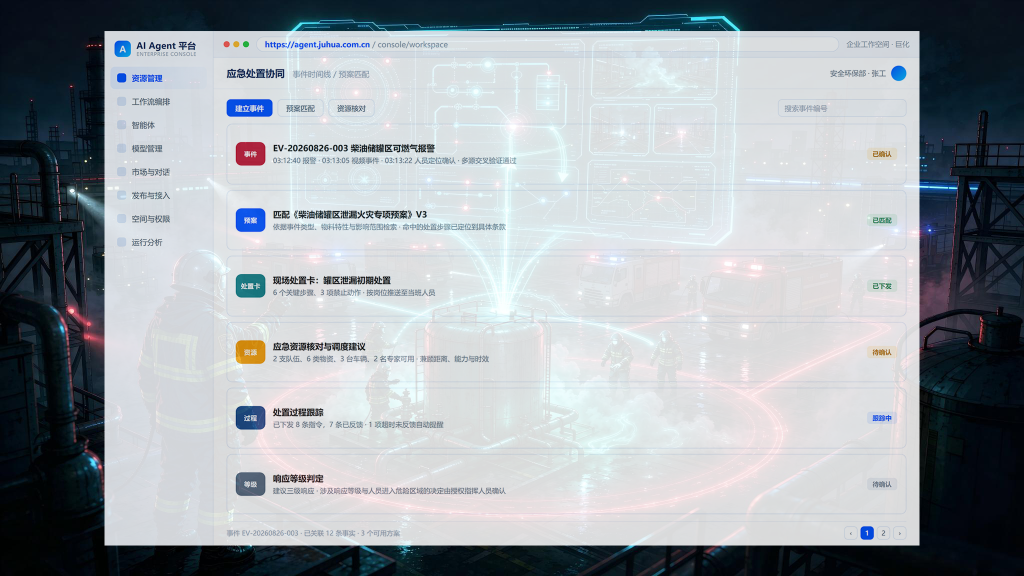
In the face of emergencies such as hazardous chemical leaks, fires, and explosions, traditional emergency response often delays opportunities due to fragmented information and difficulty in correlating multi-source alarms. Manual assessment is slow, resource scheduling lacks a global perspective, and post-event reviews are difficult to quantify. This agent rapidly aggregates alarm, process, video, personnel, meteorological, material, and resource information to form a unified factual snapshot, assisting event verification, level judgment, plan matching, action recommendations, and process tracking. Core capabilities include event fusion perception and grading, evidence package generation, plan and handling card matching, resource verification and scheduling recommendations, handling process tracking, review, and plan optimization. The execution chain is as follows: the system verifies data to form a factual snapshot and generates an evidence package and action recommendations, which are pushed to commanders; authorized commanders confirm and issue them for execution; execution feedback flows back for model optimization. Key decisions are always made by authorized commanders; AI only serves as an “advisor” and does not “command.” Review conclusions automatically flow back to the risk list of the hidden danger inspection agent, forming a complete closed loop of “handling—review—prevention.”

The Bangandi AI Agent Platform does not start from scratch. Instead, it reuses the existing large model foundation, unified knowledge base platform, and safety production management and control system. Through RAG retrieval enhancement, intelligent data querying, workflow orchestration, and standardized APIs, the five core agents work collaboratively. From hidden danger inspection, risk early warning, special operations control, to emergency response, and then to plan knowledge support throughout the entire process, the five agents are building a full-scenario intelligent defense line for industrial safety, helping enterprises achieve proactive early warning, intelligent decision-making, and closed-loop management. Industrial safety AI agents are not a simple tool upgrade but a profound transformation of safety management models. Bangandi is willing to join hands with partners to use the power of AI to make risks “visible,” early warnings “fast,” and handling “accurate,” jointly moving toward a new era of safety characterized by proactive prevention and intelligent decision-making.