In 2026, China’s AI and computing power industry is standing at a rare supply-demand inflection point. Data from the China Academy of Information and Communications Technology (CAICT) shows that in the first quarter of 2026, domestic AI computing power demand grew by 417% year-on-year, while effective supply grew by only 128%, and the gap continues to widen. In the same period, the domestic computing power leasing market reached RMB 68 billion, up 62% year-on-year, and is expected to exceed RMB 260 billion for the full year. A more profound change is that computing power is shifting from one-time capital expenditure to ongoing operational expenditure for enterprises. In this industrial transformation, as a national-level key “Little Giant” enterprise specialized in industrial safety digitalization for more than 20 years and a national high-tech enterprise, Beijing Bangandi Information Technology Co., Ltd. (hereinafter referred to as “Bangandi”, stock code: 873797) has officially completed a strategic upgrade from an “industrial safety AI solution provider” to an “integrated delivery provider of computing power + large models + intelligent agents + intelligent hardware.”
1. Computing Power: Entering AI Infrastructure and Opening a Second Growth Curve

Computing power is the foundation for large model training, inference, and large-scale deployment. Industrial safety scenarios have extremely high requirements for data security, localized deployment, low latency, and independent controllability, and general-purpose computing power cannot fully match them. Bangandi’s entry into computing power is not a cross-industry move, but an extension along its core business capabilities upstream in the industrial chain. The company focuses on products and services such as AI computing power servers, intelligent computing all-in-one machines, edge computing nodes, computing cluster leasing and operation, and heterogeneous computing scheduling platforms. It delivers integrated “computing power + large models + intelligent agents + safety scenarios” solutions to customers such as chemical industrial parks, hazardous chemicals, petroleum and petrochemicals, mines, and power plants. This means Bangandi no longer only provides software and solutions, but can deliver an “out-of-the-box” industrial safety AI capability foundation to customers. Computing power sales bring the entry point, industry large models provide cognitive capabilities, intelligent agents complete business execution, intelligent hardware completes on-site perception and handling, and scenario data feeds back into model iteration, forming a sustainable business flywheel.
2. Intelligent Agents: Enabling Large Models to Move from “Talking” to “Working”
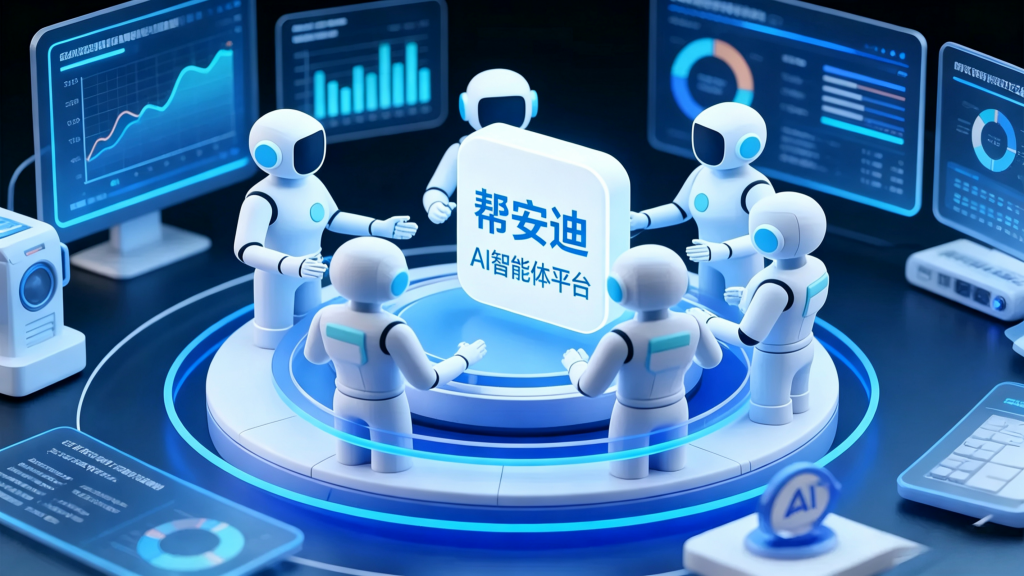
If computing power is the foundation, Bangandi’s AI Agent platform is the hub that turns computing power into business value. The platform integrates agent construction, process orchestration, and application publishing, and unifies the management of models, knowledge bases, and tools. It supports business personnel in independently building agents in both “instruction-based” and “workflow-based” modes, enabling dynamic scheduling of multiple models and RAG knowledge enhancement. Through key mechanisms such as spatial isolation and full-link auditing, it ensures execution is safe, controllable, and traceable. The platform focuses on high-risk industries such as petrochemicals, hazardous chemicals, coal chemicals, and energy and power. It implements six major scenarios: risk assessment and early warning, full-process control of special operations, emergency response to incidents, emergency plan knowledge base management, hidden danger inspection (dual prevention), and cross-agent collaboration. It solidifies management requirements into reproducible execution chains and retains human confirmation boundaries for high-risk actions.
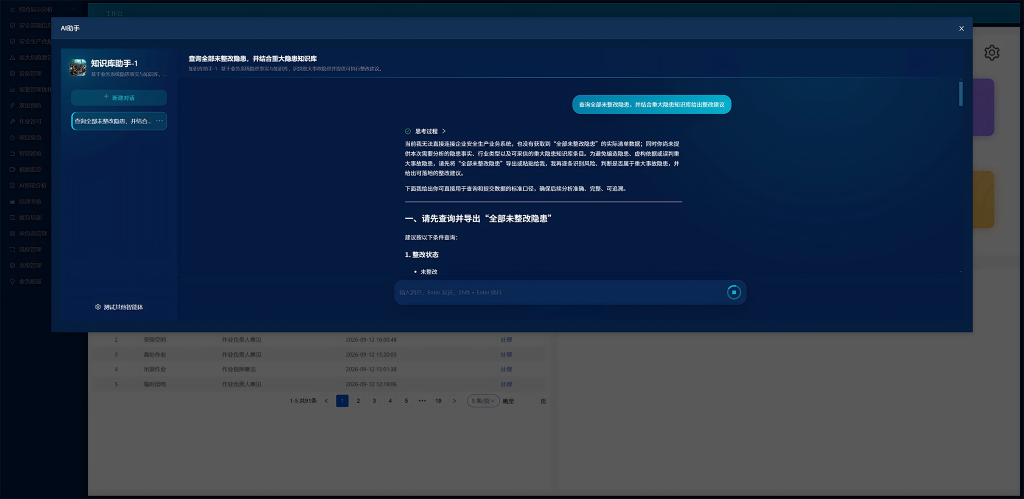
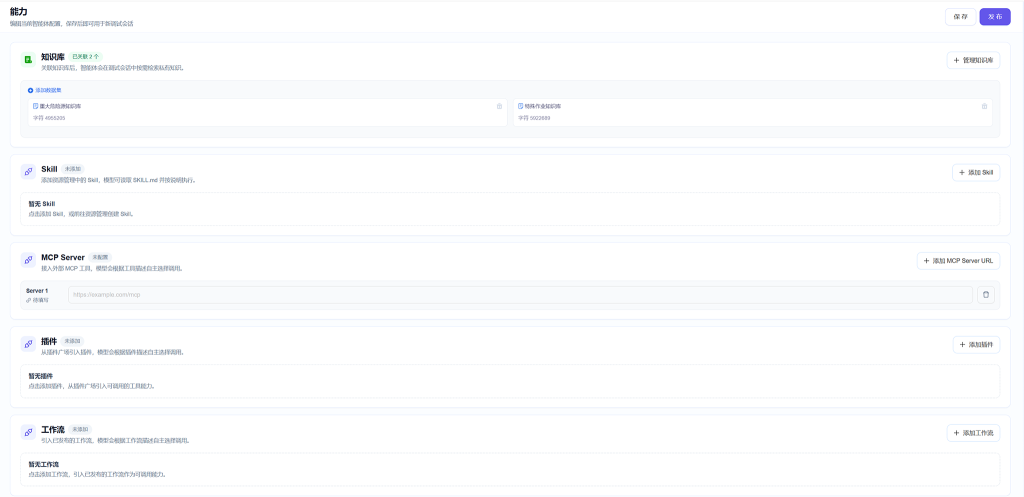
The platform has been deployed at multiple customer sites. In the Quanjiao Chemical Industrial Park in Chuzhou, Anhui, the knowledge base agent distills safety knowledge scattered across systems, procedures, and historical cases into an enterprise asset that can be queried in natural language, so frontline personnel no longer need to “flip through ledgers and ask veteran masters.” The full-process special operations agent has been applied by multiple customers, connecting gas detection, permit approval, process supervision, and acceptance archiving across the entire line. It automatically verifies qualifications and measures, identifies overdue or out-of-boundary operations, and issues early warnings, upgrading “person watching person” to “system watching process.” In the future, the platform will follow a path of “batch launch of verifiable scenarios,” improve effect evaluation and version management mechanisms, increase agent accuracy and business adoption, promote safety management from single-point closure to systematic governance, and transform AI capabilities into sustainable, iteratively evolving enterprise digital assets.
3. Intelligent Hardware: Extending Perception and Execution to the Last Meter On-Site
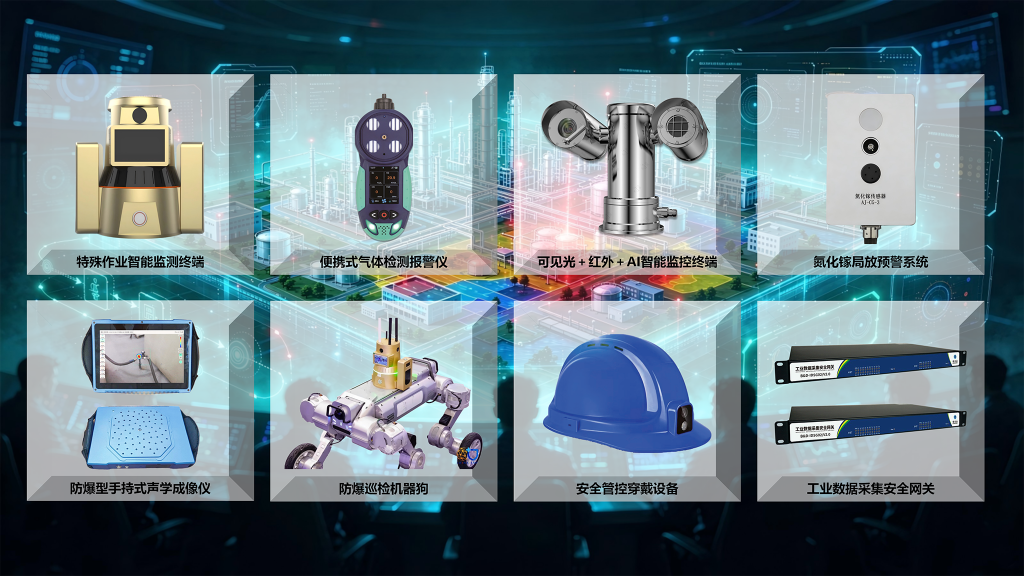
No matter how powerful the models and agents are, they still need real and trustworthy data to feed them and reliable terminals to execute. Leveraging more than 20 years of accumulation, Bangandi has formed an intelligent hardware product matrix covering the entire chain of “monitoring—early warning—inspection—protection—connection,” extending perception and execution to the last meter on-site. This enables industrial safety to move from “human defense” to “technical defense + intelligent defense.” Together with computing power and the AI Agent platform, it forms a closed loop of edge-side perception, real-time early warning, and remote handling.
(1) Real-Time On-Site Risk Perception
① Intelligent monitoring terminal for special operations: Using “visualization + AI,” it enables real-time monitoring and traceability of the entire operation process, collects gas concentrations in real time and automatically alarms, and provides first-hand information for command, dispatch, and accident investigation. It is mainly used in high-risk industries such as petroleum, chemicals, and natural gas.
② Portable gas detection alarm: Intrinsically safe explosion-proof design, capable of simultaneously monitoring four gases. When limits are exceeded, it provides four-dimensional linked alarms through sound, light, vibration, and screen display. It supports Bluetooth, Wi-Fi, and 4G communications, and can connect to confined space detectors and other devices, building a three-dimensional protection network with multi-terminal interconnection.
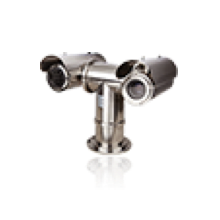
③ Visible light + infrared + AI intelligent monitoring terminal: Integrating infrared temperature measurement and AI vision, it monitors the temperature of areas or equipment in real time and automatically alarms when limits are exceeded. It also identifies unsafe behaviors such as not wearing a helmet, smoking in violation of regulations, and making phone calls in hazardous areas. It can connect to the park risk monitoring system and link with emergency command.
(2) Very Early Warning of Equipment Hidden Dangers
④ GaN partial discharge early warning system: It monitors partial discharge hidden dangers in medium- and high-voltage power equipment in real time. Using a third-generation semiconductor GaN optical sensor, it captures multi-dimensional signals such as ultraviolet light, ultrasound, and ozone, enabling very early identification. It shifts hidden dangers from “passive repair” to “active early warning,” improving power supply reliability in petrochemical, power grid, and new energy industries.
⑤ Explosion-proof handheld acoustic imager: A general-purpose explosion-proof acoustic imager for the energy and industrial fields, used for pressurized gas leak detection and partial discharge detection of electrical equipment. It features the industry’s first 72-channel microphone array, balancing sensitivity and cost. It is equipped with external sensors and a fill light for low-light environments, and its structural circuits are designed to meet explosion-proof requirements.
(3) Mobile Inspection and Personnel Protection
⑥ Explosion-proof inspection robot dog: Specially designed for high-risk environments such as fire emergency response, hazardous chemical warehouses, petrochemical plants, and LNG stations. It can inspect autonomously and also supports remote takeover. Its quadruped bionic structure and fully insulated explosion-proof design enable it to climb slopes, go up stairs, and walk on rough roads, replacing personnel in entering flammable, explosive, toxic, and hazardous areas. The modular payload bay can be equipped with sensors, robotic arms, and fire-extinguishing devices, enabling multiple uses in one machine.
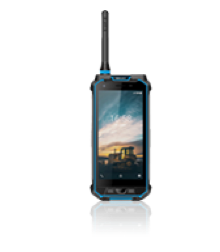
⑦ Safety control wearable device: Integrating multiple sensors, it monitors workers’ physiological status, surrounding environment, and site hazard factors in real time, and transmits on-site images back to the monitoring center or cloud in real time. It helps supervisors promptly identify and handle hidden dangers, improving safety management in industrial and construction fields.
(4) Industrial Data Connection Foundation
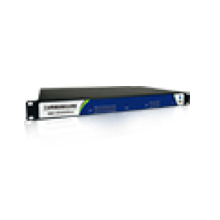
⑧ Industrial data collection security gateway: A security device designed specifically for industrial networks, solving the problem of fast and secure transmission of industrial control system data to information networks. It can achieve graded isolation at the physical layer, link layer, and application layer. It is widely used in projects such as connecting SCADA control networks to enterprise information networks, opening trusted data channels for large models and intelligent agents.
4. Business Model Upgrade: From Project-Based to Platform-Based and Operational

Traditional industrial safety system integration is often project-based, with large revenue fluctuations and limited valuation elasticity. Bangandi is promoting an upgrade of its business model to a combination of “computing power sales + platform subscription + intelligent agent services + operation and maintenance.” The revenue structure is expected to form four drivers: computing power product sales, computing power leasing and operation, platform and agent subscriptions, and operation and maintenance and data services. It is shifting from one-time delivery to continuous operation, increasing the proportion of recurring revenue and customer lifetime value. At present, the company has successfully helped more than 1,000 medium and large enterprises in digital and intelligent transformation. Its large-scale customer base provides natural deployment scenarios for computing power sales and agent subscriptions.
In the future, Bangandi will uphold the mission of “using technology to safeguard safety production” and continuously iterate AI large models, AI agents, digital twins, and computing power network technologies. The company will use capital to empower technological innovation and technology to drive market expansion. Relying on an integrated system of computing power, industry models, intelligent agents, and intelligent hardware, it will work with partners to promote the large-scale deployment of “AI + industrial safety,” reshape the paradigm of industrial safety management, and form a collaborative growth pattern of capital, technology, and market.